LDSRx · Antibiotic stewardship
Turn PCR results into a treatment plan
LDSRx links each resistance gene to its associated organisms based on guidelines and literature, then recommends guideline-based drugs and doses. Your lab reviews and approves every report.
Supported syndromic panels
- UTI
- Wound
- Skin
- Gastrointestinal
- Respiratory
- STI
- Women’s health
- Dermatology
- Nail
- Fungal
Supports CAP MIC.65630 Reporting
HL7 & API Integration
Guideline-Based Recommendations
24/7 Expert Support
The Problem
Your PCR panel found the pathogens. Choosing the right drug is still on you.
PCR panels detect pathogens and resistance genes in hours, but a raw PCR report leaves the clinician to work out which organism matters, which drugs the genes affect, and what to prescribe. In polymicrobial specimens, molecular results alone can’t say which organism carries a resistance gene (LDSRx client notification, Oct 2025).
LDSRx turns those results into an organism-specific, guideline-based report a clinician can act on.
43
resistance genes and gene families recognized, covering the 109 gene targets that panels report.
Source: (Medical Database white paper, 2026)
94
disease-causing pathogens mapped to resistance genes across UTI, wound, skin, GI, respiratory and STI panels.
Source: (Medical Database white paper, 2026)
1,853
documented links showing which pathogens can carry which resistance genes.
Source: (Medical Database white paper, 2026)
Why LDSRx
From PCR results to a treatment plan your clinicians can use
Guideline-based interpretation
Our algorithm and scoring system analyze PCR results for pathogens and resistance genes, and recommend drugs based on current clinical guidelines.
Reports built for the prescriber
Each report lists detected pathogens with microbial load, resistance genes, and specific drug and dose recommendations.
Easy setup, real-time reports
A self-explanatory portal with simple setup and configuration, and real-time analysis and reporting.
24/7 clinical and technical support
Round-the-clock help from our clinical, pharmacy and technical experts.
How It Works
From PCR result to treatment plan in four steps
LDSRx turns PCR results into a treatment report. Your lab reviews and approves every report.
Step 1: Send results
Your LIS sends PCR results and patient details to LDSRx through HL7 or API.
Step 2: Analyze the PCR data
LDSRx identifies the detected pathogens and links each detected antibiotic resistance gene to them, based on guidelines and literature.
Step 3: Get treatment options
A drug of choice and alternatives, with route, dose and warnings, based on current guidelines.
Step 4: Review and release
Your lab approves the report, then it goes to your LIS, EMR or decision support system.
Sample Reports
See the report your clinicians receive
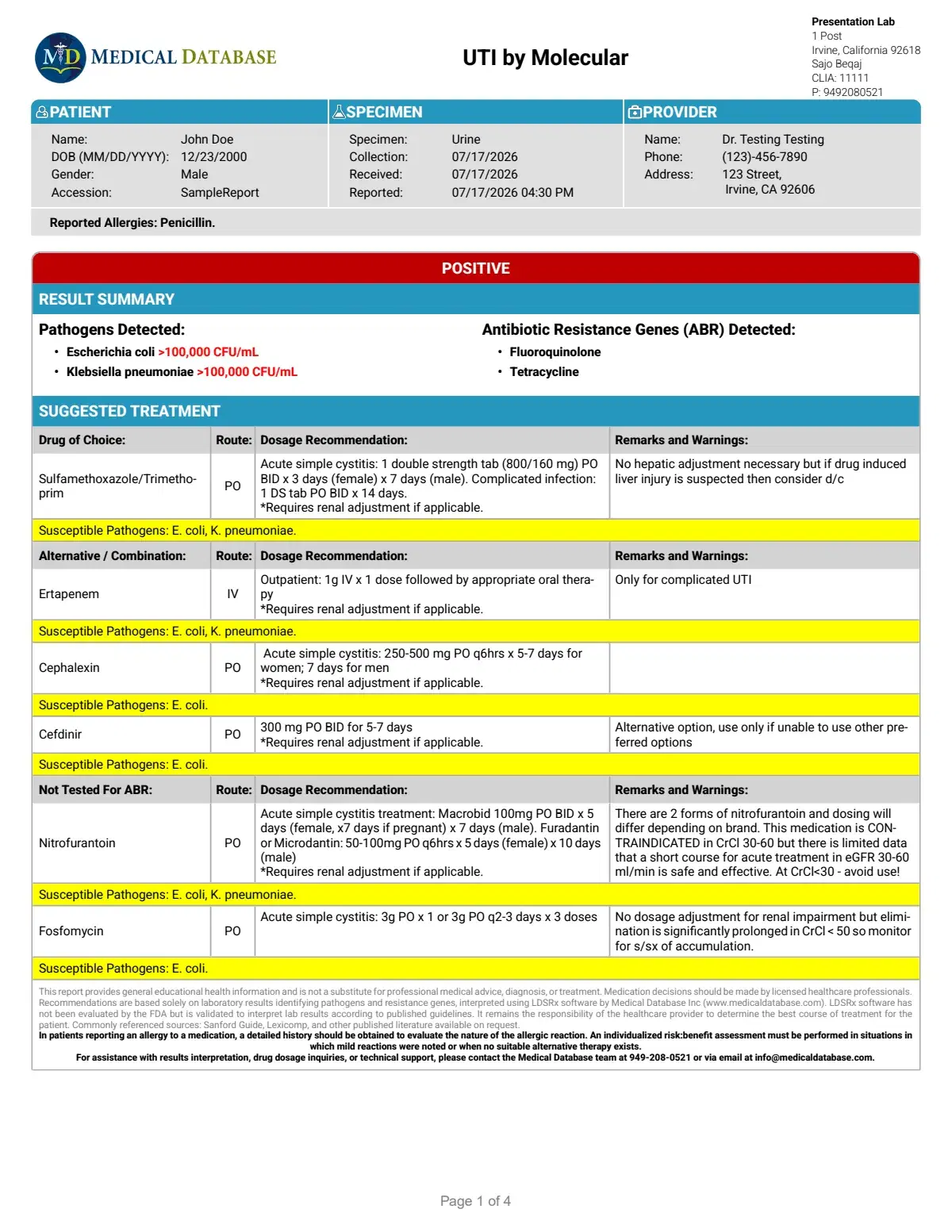
Every LDSRx report puts the detected pathogens, their resistance genes and a guideline-based treatment plan in one document. Preview a panel below, then get the full sample reports by email.
Full 4-page report by email
Urinary tract infection panel
- 2 pathogens detected
- Per-organism S / R drug grid
- Penicillin allergy applied
What’s inside
Result summary and suggested treatment
Both detected pathogens with microbial load, the resistance gene classes found, and a drug of choice with alternatives. Each drug lists route, dose, remarks and warnings, and the pathogens it covers. The reported penicillin allergy is shown at the top.
Pathogen results
Every pathogen on the panel, grouped as gram-negative, gram-positive, virus, fungi and parasite, with detected organisms flagged by microbial load and grade.
Resistance genes, linked to pathogens
Each detected resistance gene is shown with the detected pathogens it is linked to. Genes not linked to any detected pathogen are marked “Not Applicable.”
Antibiotic recommendations by organism
Every antibiotic, grouped by class, marked for each detected pathogen as susceptible (S) or resistant (R). Because of the reported allergy, penicillins are marked “A” for allergy.
Get all 3 sample reports
Enter your email and we’ll send them to you right away.
UTI sample report · 4 pages
Wound sample report · 4 pages
STI sample report · 2 pages
Sample reports contain test data, not real patient information. Report layout and the pathogens and resistance genes covered depend on the panel your laboratory runs.
Who It’s For
Who LDSRx is for
Molecular and reference labs
Deliver a treatment-ready report from UTI, wound, skin, GI, respiratory, STI, women’s health, dermatology, nail or fungal panels.
Laboratory directors
Attribute resistance genes to organisms, in line with CAP requirement MIC.65630.
Ordering clinicians
Get drug and dose options right next to the pathogens detected.
Stewardship teams
Support appropriate antibiotic use with organism-specific, guideline-based advice.
Pharmacists
See resistance mechanisms and the drug classes they affect at a glance.
Lab software partners
Offer interpreted syndromic reporting to your customers.
Integrations
Built to plug into your existing lab workflow
LDSRx exchanges data with your systems over HL7 or API, so results flow in and finished reports flow back without re-keying.
Interfaces
LDSRx interfaces through HL7 or API with LIMS and CDS systems, collecting the data it needs and sending finished reports directly to the LIS, CDS or EMR.
- HL7
- API
- LIMS / LIS
- CDS
- EMR
Supported syndromic panels
LDSRx produces treatment reports for ten panel types.
- Urinary tract infection (UTI)
- Wound
- Skin
- Gastrointestinal (GI)
- Respiratory
- Sexually transmitted infection (STI)
- Women’s health
- Dermatology
- Nail
- Fungal
Laboratory software partners
LDSRx works with the following laboratory software platforms. It is also available through CrelioHealth.
- GoRev
- Ovation
- CrelioHealth
- Labgen
- truemedIT
Product and company names are trademarks of their respective owners and are used only to identify systems Medical Database can integrate with. Their use does not imply endorsement. Available integrations vary by implementation; contact us to confirm support for your system and version.
How to Buy
How to get LDSRx
LDSRx is priced per report, so cost follows your volume.
Volume-based pricing
$5–$12 per report
Request a quoteThe per-report price depends on your monthly report volume: the more reports you run, the lower the price per report.
Getting started
Talk to our team- Request a demo and tell us which panels you run.
- Receive a per-report quote based on your expected volume.
- Set up the HL7 or API interface between your LIMS and the LDSRx portal.
- Review sample reports with your team, then go live.
LDSRx is also available through CrelioHealth. Clinical, pharmacy and technical support is available 24 hours a day, 7 days a week.
Proof
How the LDSRx knowledge base was built
LDSRx recommendations rest on a documented, curated knowledge base. These are the documents that describe it.
Beqaj S, Shrestha R, Neopane P, Le D, Patel K. Systematic Mapping of Antibiotic Resistance Genes to Clinically Relevant Microorganisms Using Curated Databases and Guidelines. Medical Database white paper. June 2026.
Study type: Methods and coverage of the LDSRx resistance-gene-to-pathogen mapping database, built from CARD, NCBI AMRFinderPlus, the EMBL-EBI AMR Portal, peer-reviewed literature, and CLSI and IDSA guidance. Not peer reviewed.
- The mapping database covers 43 canonical resistance genes and gene families, 94 pathogens and 1,853 curated gene-to-pathogen links across 15 resistance mechanism classes.
- Mappings were built from CARD (about 1,600 catalogued resistance genes), NCBI AMRFinderPlus, the EMBL-EBI AMR Portal, peer-reviewed literature, and current CLSI and IDSA (2024) guidance.
- Each candidate gene was confirmed to encode a functional resistance mechanism before it was mapped.
Medical Database. Client Notification: LDSRx Antibiotic Resistance Gene Mapping Update. October 28, 2025.
Study type: Product update notice describing how LDSRx links resistance genes to detected organisms.
- Since this update, every resistance gene detected by molecular testing is reported alongside its associated pathogen(s) in LDSRx reports.
- The update was designed to support CAP checklist requirement MIC.65630, which asks for genotypic resistance markers to be linked to a corresponding organism.
Disclosure: these documents were written by Medical Database and have not been peer reviewed. We have not published clinical outcome studies for LDSRx. Accreditation remains the responsibility of each laboratory.
FAQs
LDSRx questions, answered
Which syndromic panels does LDSRx support?
LDSRx produces treatment reports for urinary tract infection (UTI), wound, skin, gastrointestinal (GI), respiratory, sexually transmitted infection (STI), women’s health, dermatology, nail and fungal panels. Our 2026 resistance-gene mapping white paper covers the UTI, wound, skin, GI, respiratory and STI panels.
How does LDSRx link resistance genes to pathogens?
It uses a curated mapping database of 43 resistance genes and gene families linked to 94 pathogens, built from CARD, NCBI AMRFinderPlus, the EMBL-EBI AMR Portal, peer-reviewed literature, and CLSI and IDSA guidance. Each detected gene is reported alongside the detected organisms it is linked to, based on guidelines and literature.
Does LDSRx make our lab CAP compliant?
No software can make a laboratory CAP compliant on its own; accreditation is the lab’s responsibility. LDSRx links each detected resistance gene to its corresponding organism(s), which is designed to support CAP checklist requirement MIC.65630.
Who approves the final report?
Your laboratory does. The completed report is exported back to your LIMS for final review and approval. Prescribing decisions remain with the treating clinician.
Does LDSRx replace susceptibility testing?
LDSRx interprets molecular test results for pathogens and antibiotic resistance (ABR) genes. Because this is genotypic testing rather than culture-based phenotypic testing, LDSRx does not measure susceptibility directly. Instead, it predicts the likely susceptibility of detected pathogens to recommended drugs, based on the pathogens and resistance genes detected and current clinical guidelines.
How much does LDSRx cost?
Pricing is per report and ranges from $5 to $12 depending on your monthly volume. Contact us for a quote.
Which laboratory systems does LDSRx work with?
LDSRx connects through HL7 or API with LIMS and CDS systems and delivers reports to the LIS, CDS or EMR. It works with laboratory software platforms including GoRev, Ovation, CrelioHealth, Labgen and truemedIT.
What support is included?
Clinical, pharmacy and technical support from clinical and pharmacy experts is available 24 hours a day, 7 days a week.
Medical Database products provide decision support. They do not replace the professional judgment of the ordering provider, laboratory director, or treating clinician, and they do not guarantee coverage or payment, which are determined by each payer.
Request a demo
See an LDSRx report built from your panel
We’ll walk you through a treatment report for the panels you run, and how it reaches your LIS or EMR.
- We reply to schedule a time that suits you
- See how it fits your current workflow
- Ask our team about setup and pricing